
What lives inside the breast
6 min read
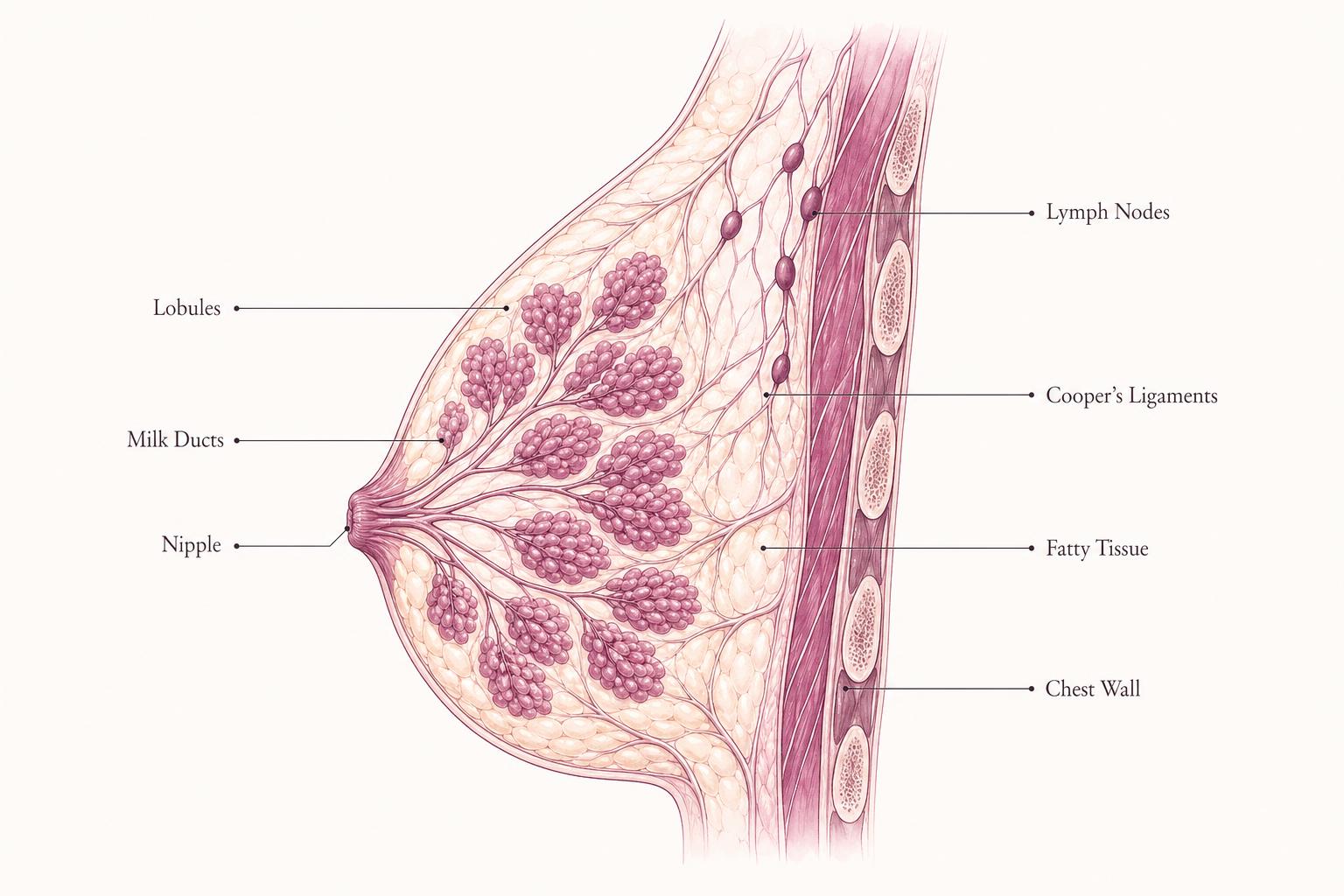
A breast is not one smooth piece of tissue. It is a layered mix of soft fat, milk-making glands, tiny tubes, supportive bands, blood vessels, and lymphatic channels. Once you know what is inside, the natural ridges, softness, and uneven texture you feel make much more sense.
Lobules, the small glands
Lobules are clusters of tiny glands that can make milk. You can picture them a little like bunches of grapes. Even when you are not breastfeeding, they are still part of the breast's normal structure. Because glandular tissue is naturally clustered, it can feel pebbly or finely bumpy under your fingers.
Milk ducts, the small pathways
Milk ducts are narrow tubes that carry milk from the lobules toward the nipple. They branch through the breast much like the stems on those bunches of grapes. Together, the ducts and lobules create much of the firmer, more textured tissue that women often notice, especially in the upper outer part of the breast.
Adipose tissue, the soft layer
Adipose tissue simply means fat. It fills the spaces around the glands and ducts, protects them, and gives the breast much of its size and softness. Every woman has a different mix of fatty and glandular tissue, which is one reason one person's breasts may feel softer while another person's feel naturally firmer or more textured.
Cooper's ligaments, the inner supports
Cooper's ligaments are fine bands of connective tissue that run through the breast and help hold its shape. They connect the skin to the deeper chest tissue, creating an internal support system. These bands can contribute to the ropey or ridged feeling that is part of normal breast texture.
Lymphatic channels, the gentle drainage network
Lymphatic channels are tiny pathways that move fluid through the breast toward nearby lymph nodes, especially those around the underarm and collarbone. They are part of the body's everyday fluid balance. This network is one reason gentle movement and light massage can feel comforting when breasts feel full or heavy.
Why breast tissue is rarely uniform
All of these structures sit beside and over one another, and they are not arranged in a perfectly even pattern. One area may have more glandular tissue, another more fat, and another a firmer supporting band. The two breasts are sisters, not twins, so their texture and size may differ a little too. Natural breast tissue has texture, and completely smooth or perfectly matching breasts are not the usual baseline.
How hormones change what you feel
Breast tissue responds to estrogen and progesterone. Before a period, the ducts and lobules can swell slightly and hold more fluid, making the breasts feel fuller, bumpier, or more tender. After the period begins, that fullness often settles. Feeling your breasts at the same point in your cycle each month makes it easier to recognize your own usual pattern.
How life stages shape the breast
Breasts keep changing through puberty, pregnancy, breastfeeding, and menopause. Glandular tissue develops, prepares for feeding, settles afterward, and gradually gives way to more fatty tissue later in life. Changes in birth control, hormone support, weight, and the menstrual cycle can also affect fullness and tenderness. There is no single texture a breast must keep for life.
Familiar is more useful than perfectly smooth
Knowing your own usual texture is more helpful than expecting your breasts to feel completely uniform. A gentle monthly check-in, at the same point in your cycle when possible, helps you learn what belongs to you. If you notice a new change that stays, or one of the six changes we recommend having assessed, let a clinician take a proper look.
Want this mapped to your own situation? The quiz takes about a minute.
Take the quiz